


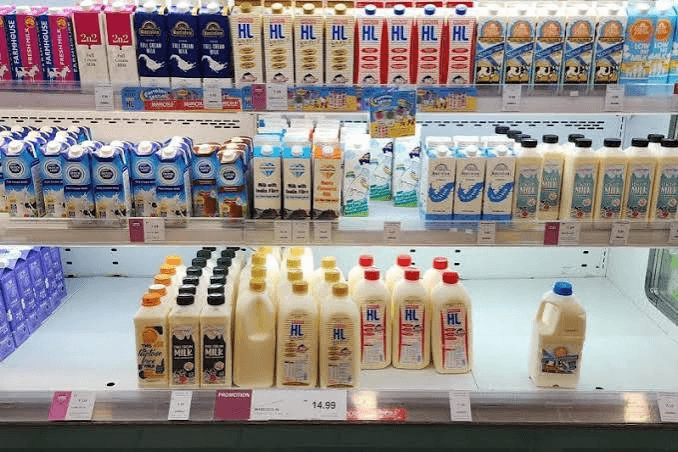
If you’ve been following food news lately, you may have seen two very different headlines sitting side by side. One warns of milk shortages and empty dairy shelves. Another describes a “tsunami of milk” flooding global markets. Both can’t be right — or can they?
The reality is more layered than either headline suggests. This article breaks down what’s actually happening with dairy supply right now: the difference between local disruptions and global output, why farms can be struggling even when production is high, and what a quietly shrinking heifer population might mean for milk supply in the years ahead.
There Is No Global Milk Shortage — But That Does Not Mean Supply Is Stable
Let’s start with the most important clarification. There is no global milk shortage in 2025 or 2026. Global milk output is projected to reach approximately 980 million metric tons by 2026, with the world’s major dairy-exporting nations adding supply, not pulling back.
In the United States specifically, the USDA projects milk production will grow roughly 1.3% in 2026, reaching around 234.5 billion pounds. That growth comes from both a modestly larger herd and higher yield per cow.
In fact, some analysts are worried about the opposite problem. Industry observers have described early 2026 as a period of potential oversupply — too much milk chasing too little demand. The phrase “tsunami of milk” has been used to describe what could happen to prices if production continues at its current pace.
So the more accurate concern is not empty shelves on a global scale. It’s price volatility, low farmgate returns, and uneven distribution across regions. Those are real problems — just different ones from what the word “shortage” implies.
Local Shortages Are Real and Can Happen Fast
Even when global supply is healthy, a shortage can develop in a specific city or country within days. The mechanics are straightforward: modern dairy supply chains carry very little buffer stock, especially for fresh fluid milk.
A clear example unfolded in early 2026 in Israel. Dairy farmers and processors launched a strike, halting milk deliveries to supermarkets. Within days, stores began rationing fresh milk. Partial shortages of cottage cheese and soft cheeses followed. Dairies were operating only on existing inventory, which analysts expected to last just a few days.
This had nothing to do with a global lack of cows. It was a labor and industry dispute that exposed how thin the margin is between production and retail availability.
Other common triggers work the same way. A processing plant shutdown, a severe winter storm blocking transport routes, or a regional power failure can all remove fresh milk from shelves within 48 to 72 hours, even if production elsewhere is running above average.
Think of it like fuel supply. A country can have ample oil reserves, but if delivery drivers go on strike, local gas stations still run dry. The resource exists — it just isn’t moving.
Why Oversupply and Financial Stress Can Coexist on Dairy Farms
This is one of the more counterintuitive parts of the dairy story. How can farms be producing more milk than ever while also struggling financially?
The short answer is timing. When milk prices were strong between 2021 and 2023, many producers expanded their operations — adding cows, upgrading facilities, increasing output. That expansion worked while prices were high. But the added production eventually pushed prices back down, sometimes sharply.
Class III milk prices — the benchmark used for cheese milk — are projected to linger near $14 per hundredweight for much of 2026. For many operations, that level barely covers costs, let alone generates a sustainable profit margin.
When prices stay low for an extended period, some producers exit the market entirely. Others reduce herd size or shift toward beef-on-dairy breeding — essentially producing calves intended for beef rather than future dairy replacements. Both responses reduce the long-term supply pipeline, even if total output remains high today.
A useful comparison: imagine a bumper crop of apples. Prices at the store drop because supply is abundant. But the orchard owner is selling at a loss. The shelves are full, yet the farmer is under serious financial pressure. That tension — between consumer-level availability and producer-level viability — is exactly what the dairy industry is navigating right now.
The Replacement Heifer Problem and What It Means for Future Supply
There’s a structural issue developing quietly beneath the current oversupply conditions, and it could shift the supply picture considerably within the next few years.
The U.S. supply of replacement dairy heifers — the young cows that will eventually enter the milking herd — is at its lowest level in nearly 50 years. This matters because today’s heifer population determines tomorrow’s milk output.
The reason for the decline ties directly back to the economics discussed above. With milk prices under pressure, many dairy farmers have shifted to beef-on-dairy breeding programs. A beef-cross calf is worth more on the market right now than a dairy replacement heifer. That decision makes financial sense in the short term. But it means fewer young dairy animals are being raised to replace older cows as they leave the herd.
If a large number of productive cows are culled in the coming years and there aren’t enough heifers ready to step in, production could tighten more quickly than markets are currently pricing in.
There is no shortage today. But the decisions being made now will shape supply conditions in 2027, 2028, and beyond. It’s a slow-moving structural shift, not an immediate crisis — but it’s worth watching.
The analogy here is simple. If a school stops admitting new students to its freshman class, the building doesn’t feel empty immediately. But in a few years, the enrollment gap becomes unavoidable. The same logic applies to a dairy herd that isn’t being properly replenished.
What About the Baby Formula Shortage?
Many people associate milk shortages with the baby formula crisis that hit the United States hard in 2022 and continued rippling through 2025. It’s a reasonable connection, but the causes are different from what most people assume.
The formula shortage was not caused by a lack of cows’ milk. Raw milk supply remained adequate throughout the crisis. The real drivers were structural: a highly concentrated manufacturing industry, a major facility shutdown and recall involving Abbott’s Similac plant, and slow regulatory timelines for expanding production capacity or approving imported alternatives.
As of April 2026, the national formula out-of-stock rate has improved significantly — down to around 11% from a peak above 70% in 2022. But specialty formulas, including hypoallergenic and amino acid-based options, still face out-of-stock rates of 18–22%.
The formula situation is a manufacturing and regulatory problem, not a dairy supply problem. The distinction matters because the solutions are completely different.
What This Means for Consumers and the Broader Market
For most consumers in well-supplied markets, the immediate picture is relatively stable. Fluid milk is available, prices at retail have not spiked dramatically, and the oversupply conditions affecting farmer economics have largely been absorbed before reaching store shelves.
Where consumers are more likely to feel real disruptions is during localized events — strikes, weather, or processing failures — that cut off fresh supply quickly. In those situations, having a small backup supply of shelf-stable milk or powdered alternatives at home is practical preparation, not overcaution.
For farmers and rural economies, the environment is considerably more difficult. Prolonged low prices at the $14 per hundredweight level test the viability of operations that expanded during the high-price years. Some will adapt through niche production — organic, grass-fed, or direct-to-consumer models. Others will look at vertical integration or on-farm processing to capture more of the margin. Some will exit altogether.
Those who follow business and agricultural market trends can find useful context on topics like this through AllBizDaily, which covers economic and industry developments relevant to both businesses and general readers.
The Bigger Picture: Volatility, Not Collapse
The dairy industry in 2025–2026 is not in crisis in the way that headlines sometimes suggest. Global supply is growing, U.S. production is increasing, and the dominant short-term risk is too much milk, not too little.
But “no global shortage” does not mean “no problems.” Local disruptions can create genuine scarcity fast. Financial pressure on farms is real and could affect future production decisions. The replacement heifer deficit is a slow-burning structural issue. And the baby formula market, while improving, has not fully stabilized for families who need specialty products.
The most accurate frame for understanding dairy supply right now is not shortage or glut — it’s volatility. A system under pricing pressure, with a thinning long-term pipeline, and a supply chain that has little room for disruption. That’s a different story than empty shelves, but it’s one worth understanding clearly.
Read Also:
