


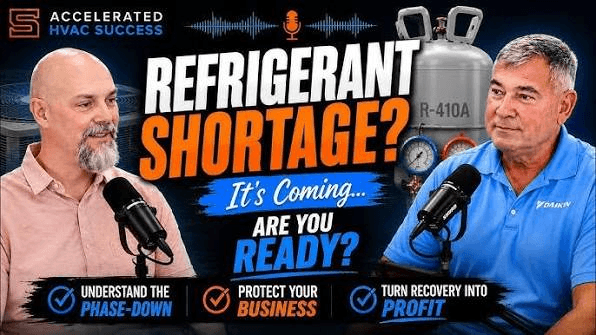
HVAC contractors and building owners across the U.S. are dealing with delayed repairs, higher costs, and uncertain timelines. This is not because refrigerant has vanished from the market. It is because the industry is in the middle of a regulated, structural transition — and supply has not kept pace with the change.
This article breaks down why the shortage is happening, which refrigerants are most affected, how the bottleneck actually works, and what homeowners and businesses can do right now.
Why There Is a Refrigerant Shortage Right Now
It would be easy to blame the shortage on a single event — a production disruption, a supply chain crisis, or sudden panic buying. But the real picture is more complicated. Three overlapping forces are driving the current situation at the same time.
The first is federal regulation. The American Innovation and Manufacturing (AIM) Act requires a gradual phasedown of hydrofluorocarbons, or HFCs. HFCs are widely used refrigerants, but they carry a high global warming potential. Under the AIM Act, the U.S. must significantly reduce HFC production and consumption over time. That means refrigerants like R-410A — which has been the standard for residential and commercial HVAC for years — are being restricted.
The second force is demand. As legacy refrigerants are phased down, everyone needs the newer, approved alternatives. That demand has spiked before the supply infrastructure for those alternatives is fully built out.
The third force is supply-chain constraints. Even where production of new refrigerants has ramped up, getting those products to market has run into real physical limitations — which we will cover in more detail below.
The important takeaway here is that this is not a one-time shortage. It is a structural market shift, and its effects will continue to play out over the coming years.
Which Refrigerants Are Most Affected
Not every refrigerant is equally hard to find right now. The shortage is concentrated around a specific transition point in the market.
R-410A has been the dominant refrigerant in residential and light commercial HVAC equipment for decades. Under the AIM Act phasedown, its long-term supply is becoming unreliable. Even if R-410A is available today, contractors and building owners cannot count on stable availability or pricing going forward.
R-454B is the primary next-generation replacement for R-410A. It has a much lower global warming potential and is now required in new residential HVAC equipment. But in 2025, R-454B has faced acute shortages. Demand has outrun the production and distribution capacity that currently exists.
R-134a, commonly used in automotive and commercial refrigeration applications, is also under transition pressure as part of the broader HFC phasedown.
One important factor shaping all of this is safety classification. Newer low-GWP refrigerants like R-454B fall into the A2L category, which means they are mildly flammable. This classification has introduced additional handling, storage, and packaging requirements that add friction across the entire supply chain.
The Cylinder Problem — Why Packaging Is Part of the Bottleneck
Here is a detail that does not make headlines often, but it explains a significant portion of the current shortage. In many cases, the refrigerant itself is not the limiting factor — the cylinders used to store and transport it are.
Because R-454B and other A2L refrigerants are mildly flammable, they require specific, compliant cylinder types. Manufacturers have struggled to produce enough of these cylinders to meet demand, even when the refrigerant itself is ready to ship.
Think of it this way: it is like having a product sitting in a warehouse, ready to go, but not having enough approved containers to legally ship it. The supply exists in one form, but the logistics infrastructure needed to move it is lagging behind.
Import pressure has added another layer of complexity. Some domestic supply gaps in 2025 have required sourcing refrigerant from international markets, which introduces longer lead times and less predictable delivery windows. Distributors have reported real uncertainty about when orders will arrive, which makes planning difficult for contractors who need to schedule service calls in advance.
Major manufacturers including Honeywell have flagged significant demand pressure in the market, and the need to import refrigerant to fill domestic gaps has been reported by industry sources. This is not a short-term logistics hiccup — it reflects how fast demand has outgrown the new supply ecosystem.
How the Shortage Affects HVAC Repairs, Costs, and Timelines
For homeowners and building managers, the shortage creates a very practical problem. A contractor may confirm a service appointment only to face delays because the required refrigerant is either unavailable in the area or priced so high that the job economics change significantly.
Prices for replacement refrigerants have increased sharply in 2025. Those cost increases flow downstream — contractors pay more, and customers pay more. In some cases, repair quotes that would have been straightforward a year ago now require a different conversation about whether a repair is worth the cost.
Timelines have also stretched out. Some equipment replacements have been pulled forward earlier than originally planned, simply because waiting for refrigerant to become available or affordable is not a viable option for a business that depends on climate-controlled environments.
The hardest situation is one that many older-equipment owners are now facing: a system that uses a refrigerant being phased down develops a leak. At that point, the choices are:
- Pay elevated recharge costs to refill the system with increasingly scarce refrigerant
- Repair the leak, then recharge — a more complete fix but still reliant on a constrained refrigerant supply
- Replace the system entirely with equipment designed for next-generation refrigerants
None of these options is ideal. But understanding them clearly helps owners make better decisions rather than reactive ones.
One thing worth clarifying: refrigerant does not deplete under normal operation. A system that is low on refrigerant almost always has a leak. That is important because it means routine maintenance and leak detection have real financial value right now. Catching a small leak early costs far less than an emergency recharge at 2025 prices.
What Homeowners and Businesses Can Do Now
The refrigerant transition is not something individual owners can reverse. But there are practical steps that reduce exposure to its worst effects.
Schedule Preventative Maintenance
Regular inspections help identify leaks or declining performance before they become emergencies. This is always good practice, but it matters more when refrigerant costs are elevated and supply is uncertain. A small refrigerant leak found during a routine check is far cheaper to address than an unexpected system failure in the middle of summer.
Know What Refrigerant Your System Uses
If your HVAC equipment is more than a few years old, it likely uses R-410A. Understanding that puts you in a better position to ask your contractor the right questions and to plan realistically for the future. Systems still using older refrigerants like R-22 are in an even more constrained position, since that refrigerant is further along in its phaseout.
Have an Honest Repair-vs-Replace Conversation
If your system is aging and already showing signs of declining performance, now is a reasonable time to evaluate replacement options — before a failure forces the decision under time pressure. New equipment is designed for low-GWP refrigerants, which means better long-term supply stability. That consideration is now part of the calculus in a way it was not three years ago.
Work With Contractors Who Are Sourcing Proactively
Not all contractors are equally prepared for this transition. Those who are actively managing their refrigerant inventory, building supplier relationships, and staying current on A2L handling requirements will be better positioned to complete jobs on time. Asking about refrigerant availability before scheduling a repair is a reasonable question today.
For more business and industry news that helps you stay informed, visit AllBizDaily.
A Market in Transition, Not in Collapse
It is worth being clear about what this shortage is and what it is not. The refrigerant market is not in freefall. Refrigerants are still available. Equipment is still being serviced and installed. But the transition from legacy HFCs to next-generation low-GWP alternatives is creating real friction — in pricing, in supply timelines, and in the decisions that owners and contractors have to make every day.
That friction is likely to ease as cylinder production scales up, import logistics stabilize, and the industry fully adapts to the new regulatory environment. But that process will take time. For now, the most useful posture for anyone who depends on HVAC or refrigeration equipment is to plan ahead, maintain systems diligently, and make informed decisions rather than reactive ones.
The companies and homeowners who navigate this period best will be the ones who understood early that this is a structural shift — not a temporary inconvenience that will resolve itself without any action on their part.
Read Also:
