


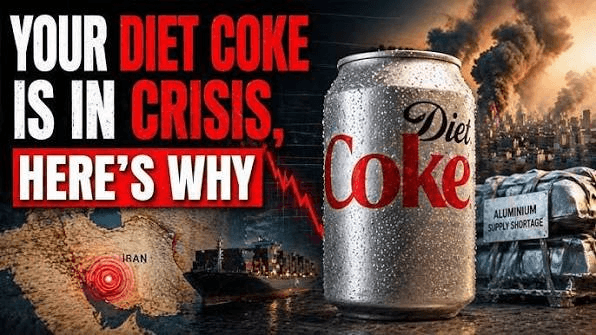
If you have been searching for Diet Coke at a supermarket or quick-commerce app in India lately and come up empty, you are not alone. Across multiple Indian cities, the familiar silver can has gone missing from shelves — and the reason has nothing to do with the drink being discontinued or reformulated.
The actual problem is the can itself. This article breaks down where the shortage is happening, what is causing it, and what consumers can reasonably expect going forward.
Where the Diet Coke Shortage Is Actually Happening
The shortage is concentrated in India. Reports of empty shelves and “unavailable” listings on quick-commerce platforms have surfaced across several Indian cities. This is not a global event, and there is no confirmed equivalent shortage in the United States or the United Kingdom.
The Independent noted that reports of a UK shortage were not substantiated. Availability within India also varies — some cities and retailers are more affected than others, and certain sales channels may still have stock while others show nothing.
So if you are outside India and reading this because you saw an alarming headline, the situation as reported does not apply to your market. The shortage is real, but it is market-specific.
The Real Bottleneck Is Aluminum Cans, Not the Drink Itself
This is the most important detail to understand. In India, Diet Coke is sold exclusively in aluminum cans. There is no widely available bottle format for the product in that market.
That single fact changes everything. Because the product exists only in one packaging format, the entire supply chain depends on a steady flow of aluminum cans. If cans run short, the product cannot reach consumers — even if the beverage syrup and formula are perfectly available.
Think of it like a restaurant that has all the ingredients ready in the kitchen but has run out of plates. The food exists, but it cannot be served until the packaging problem is resolved. Reuters and CBC both confirmed that the drink itself is not the issue — the constraint is entirely at the packaging level.
Why Aluminum Can Supply Tightened in India
Several domestic factors contributed to the can shortage, and they compounded each other at the wrong time.
Regulatory friction: India’s Bureau of Indian Standards (BIS) requires certification for aluminum beverage cans. According to Business Today, this certification requirement added regulatory friction to the supply chain and limited how quickly can manufacturers could scale up production to meet demand.
Demand miscalculation: Moneycontrol reported that domestic can manufacturers appear to have underestimated summer demand. As temperatures rose sharply, demand for cold canned beverages spiked — and the industry was not adequately prepared for the volume.
Import compliance delays: Bringing in additional can inventory from international suppliers was further slowed by import compliance requirements, which added another layer of delay on top of an already constrained domestic supply.
It is also worth noting that Diet Coke is not the only product affected. India Today confirmed that the aluminum can shortage has hit other canned beverages as well. The pressure on the supply chain is broader than a single brand or product.
How the Iran Conflict Disrupted Aluminum Shipments
On top of the domestic supply issues, a geopolitical factor entered the picture. Reuters reported that Coca-Cola distributors in India cited supply disruptions linked to geopolitical tension in the Middle East — specifically, the Iran conflict — which affected shipping routes and aluminum supply chains through the Gulf region.
Shipments that would typically move through Gulf trade routes faced delays, creating an additional constraint on top of the existing domestic pressures. This is not a small detail. India sources a portion of its aluminum and packaging materials through supply chains that run through or near the Gulf region, and any disruption to those routes has downstream effects on industries that depend on that material.
That said, it would be inaccurate to present the Iran conflict as the single cause of the shortage. It is one significant contributing factor within a broader set of problems that were already developing. The combination of regulatory friction, manufacturer miscalculation, seasonal demand spikes, and international shipping delays created a compounding effect — each problem making the others harder to absorb.
Coca-Cola’s Response and Distributor Rationing
Reuters reported that Coca-Cola distributors in India acknowledged the company was rationing supplies and could not fulfill some orders in full. This kind of rationing is a standard industry response when supply is constrained — it is a way of distributing limited stock across more customers rather than allowing some to receive full orders while others receive nothing.
Coca-Cola has stated publicly, in general terms, that increased at-home consumption and shortages of aluminum and certain ingredients have impacted supply in some markets, and that the company is working with suppliers and customers to improve availability. The company has not, based on available reporting, issued a specific timeline for full restoration of supply in India.
The absence of a firm timeline is itself informative. Supply chain disruptions of this nature — involving regulatory compliance, seasonal demand spikes, and international shipping delays simultaneously — do not resolve overnight. Distributors managing rationing while waiting for can supply to normalize suggests the situation may persist for some time before returning to normal.
What Consumers Can Realistically Expect
Availability is likely to remain inconsistent in the near term. That means Diet Coke may be available in some stores or cities but not others, and stock on quick-commerce platforms may appear and disappear without warning as limited inventory moves through the system.
A few practical points worth keeping in mind:
- The shortage is packaging-driven, not product-driven. The drink itself has not changed.
- Availability will likely vary by retailer, city, and sales channel — it is worth checking multiple sources if the product matters to you.
- Other canned beverages in India may also be harder to find for the same underlying reasons.
- There is no confirmed shortage of Diet Coke in the UK, US, or other major markets.
For consumers outside India, this story is largely a case study in how supply chains work — and how a disruption at one specific point (aluminum cans, in this case) can make a product effectively unavailable even when the product itself is fine.
For business readers tracking supply chain risk, this situation illustrates how multiple moderate disruptions — regulatory, seasonal, and geopolitical — can converge to create a significant market gap that no single fix can immediately resolve. AllBizDaily covers developments like this regularly for readers who want to stay informed on supply chain and market dynamics affecting businesses across sectors.
The Bigger Picture
The Diet Coke shortage in India is a clear example of how modern supply chains are more fragile than they appear. A product can be available in every technical sense — the formula exists, the production capacity exists, the demand exists — and still fail to reach the consumer because of a single packaging constraint.
Aluminum cans are not a glamorous part of the beverage industry, but this situation demonstrates how critical they are. When can supply tightens for any combination of reasons — regulation, manufacturing gaps, shipping disruptions — the products that depend entirely on that format are the first to disappear from shelves.
Until can supply stabilizes in India, Diet Coke availability will likely remain patchy. The most accurate expectation is not a permanent shortage, but an unpredictable and inconsistent one — which, for regular consumers, can be equally frustrating in the short term.
Read Also:
